
Mercedes’ mule front wing gives F1 its first real glimpse of 2026 active aero
At the Abu Dhabi post‑season test, Mercedes bolted a crude but crucial ‘mule’ front wing onto its W16, giving the paddock – and Pirelli – the first public, on‑track taste of the active aerodynamics that will replace DRS under F1’s 2026 regulations.
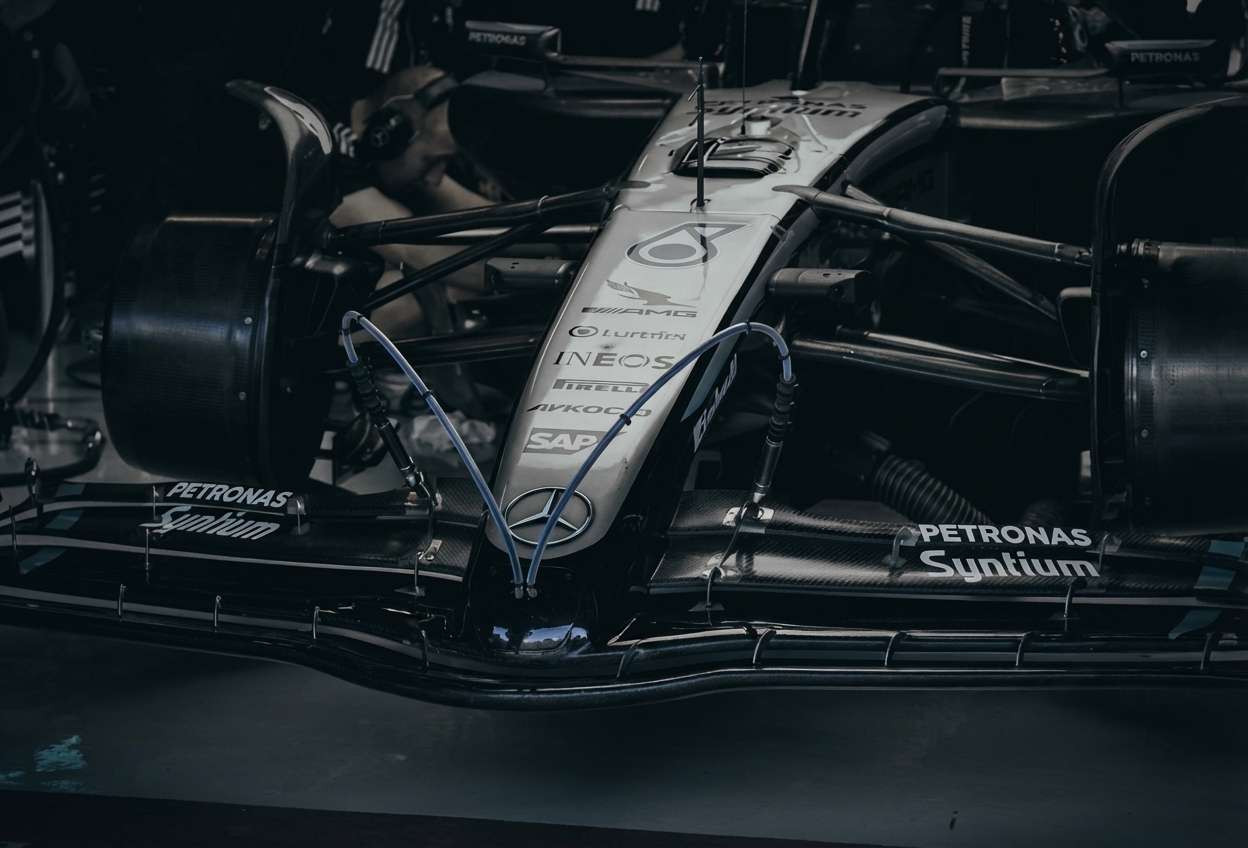
Under the Yas Marina floodlights, heat haze rippling off the asphalt and the smell of hot brakes hanging in the air, one car looked wrong. The silver Mercedes mule rolled out of the garage with a tangle of thick tubing snaking from its nose to the front wing flaps – a science project on wheels. In a test meant for tyres, Brackley had brought a glimpse of Formula 1’s future.
This was Mercedes’ prototype “Straight Line Mode” front wing, a rudimentary but working sample of the active aerodynamics that will define 2026. Bolted to Andrea Kimi Antonelli’s modified W16 mule, the system could rotate the upper front-wing elements into a low-drag setting on the straights, then pitch them back up for the corners. It’s crude by F1 standards, but as The Race noted, it is the first clearly visible example of the kind of movable front wing all teams must master for the next rules cycle.
The context matters. All ten teams were running adapted 2025 cars in Abu Dhabi, trimmed to Monza-style downforce with altered ride heights to mimic the 30% less downforce and 55% less drag the FIA says is coming for 2026. At the same time, Pirelli needed realistic data for its 2026 tyres, so the FIA opened the door to prototype front wings – and, crucially, to front-axle active aero.
Most mule cars were capped at around 300 km/h on the straights to protect the tyres. But cars equipped with a front Straight Line Mode system, like Mercedes’ mule (and Ferrari’s less visually invasive design), were exempt from that cap in FIA-defined activation zones. That made Antonelli’s laps a live-fire trial of how active aero will slash drag while keeping the car in balance when both wings are “open”.
For Pirelli, this wasn’t an engineering curiosity, it was a laboratory. Their motorsport boss Mario Isola spelled out why the FIA allowed the systems in the first place:
"Talking about the front Straight Line Mode, the FIA gave the opportunity to the teams to develop a system that was replicating this on the front wing. In that case, obviously, they don’t have to comply with the speed limit restriction… It’s also useful for us because you can compare a car that is running without the system with a car that is running with the system."
— Mario Isola, speaking to Crash.net and F1i
Zoom out, and that odd-looking Mercedes nose is the first real-world bridge between DRS and what comes next. From 2026, as the FIA and Motor Sport Magazine have outlined, cars will run moveable front and rear wings with two distinct modes: high-downforce “Z-mode” for the corners and low-drag “X-mode” for the straights. A new Manual Override will then hand a following driver extra electrical deployment when within a second of a rival, recreating DRS-style closing speed without a rear-wing flap.
That’s why Mercedes’ mule matters beyond the headlines. The exposed plumbing on the W16 – described by veteran engineer Gary Anderson as a “rather crude actuator system” – is less about lap time today and more about learning how real tyres, real suspension and real drivers respond when both axles shed downforce together. For a team still chasing its old dominance, being first to turn CFD and regulation PDFs into on-track active aero feels like the start of a necessary undercut on 2026.
And there’s a human subplot in that shimmering Abu Dhabi air. Antonelli, the teenager Mercedes is grooming for its next era, was the one feeling the steering weight change as the front wing flattened, the car knifing down Yas Marina’s back straight with less resistance than any Mercedes since DRS’ farewell race days earlier. When the lights go out on the 2026 season, the hardware will be sleeker, the plumbing hidden – but the story of active aero’s first public laps is already written, traced in a web of hoses on the nose of a mule car.
Key Facts
- Mercedes ran a prototype active front wing on its W16 mule car at the Abu Dhabi post-season test, driven by Andrea Kimi Antonelli, to simulate 2026-spec active aerodynamics.
- The system used external tubing to actuate the upper front-wing elements into a low-drag Straight Line Mode on the straights, then restored downforce for the corners.
- Mule cars were generally limited to around 300 km/h, but those fitted with a front Straight Line Mode system were exempt from that cap in FIA-designated zones.
- From 2026, DRS will be replaced by active front and rear wings with two modes – high-downforce Z-mode and low-drag X-mode – plus a Manual Override for extra electrical deployment when following another car.
- The FIA expects 2026 cars to be around 30 kg lighter with roughly 30% less downforce and 55% less drag, making early active-aero testing crucial for teams and Pirelli alike.
Sources
- Mercedes run unusual front wing design for 2026 on mule car in Abu Dhabi test | Crash.net
- First look at movable front wing prototype on F1 2026 mule cars - The Race
- Mercedes lift the lid on 2026 with prototype wing test - F1i — F1i
- First look: Mercedes rudimentary active front wing on track in Abu Dhabi - PlanetF1
- How F1 2026's new active aero will work without DRS - Motor Sport Magazine — Motor Sport Magazine
- FIA unveils Formula 1 regulations for 2026 and beyond featuring more agile cars and active aerodynamics — Formula 1
- Mercedes unveils innovative front wing design for F1 2026 season - Formulanerds — Formulanerds
- F1 2026 Aero Revolution Begins As Mercedes Unveils Radical Front Wing Prototype - Pro Football Network — Pro Football Network